

Have you ever been somewhere so bright that closing your eyes doesn’t really seem to help that much? Eyes open: way way way too bright and everything’s kinda blue-white. Eyes closed: still way too bright, but now everything’s red.
I opened my eyes again. A small group of roughly a thousand trillion photons that had spent 100,000 years finally finding their way out of our nearest thermonuclear furnace, and had then celebrated their hard-won freedom with an 8-minute joy-ride, lost control of the vehicle and smashed into my retinas at 186,000 miles per second. No direction was safe. The blazing sky was mirrored with blinding white sand below, all of the nearby plants protected themselves with white or silver coatings, and our little one-room hut was painted white to avoid cooking its occupants. It was an assault on all fronts.
Reflexively, my eyes found the only patch of shade and sheltered there. I watched, in the shade of a mighty baobab, a cluster of Gambian children that were harnessing a donkey to a cart.
“What are they doing?” I heard from behind me. Then two more kids scampered forward to join the group fussing over the donkey. I watched them stroke the contented-looking animal, and see if they could help with the rigging, and then climb excitedly onto the cart and disappear down the sandy track.
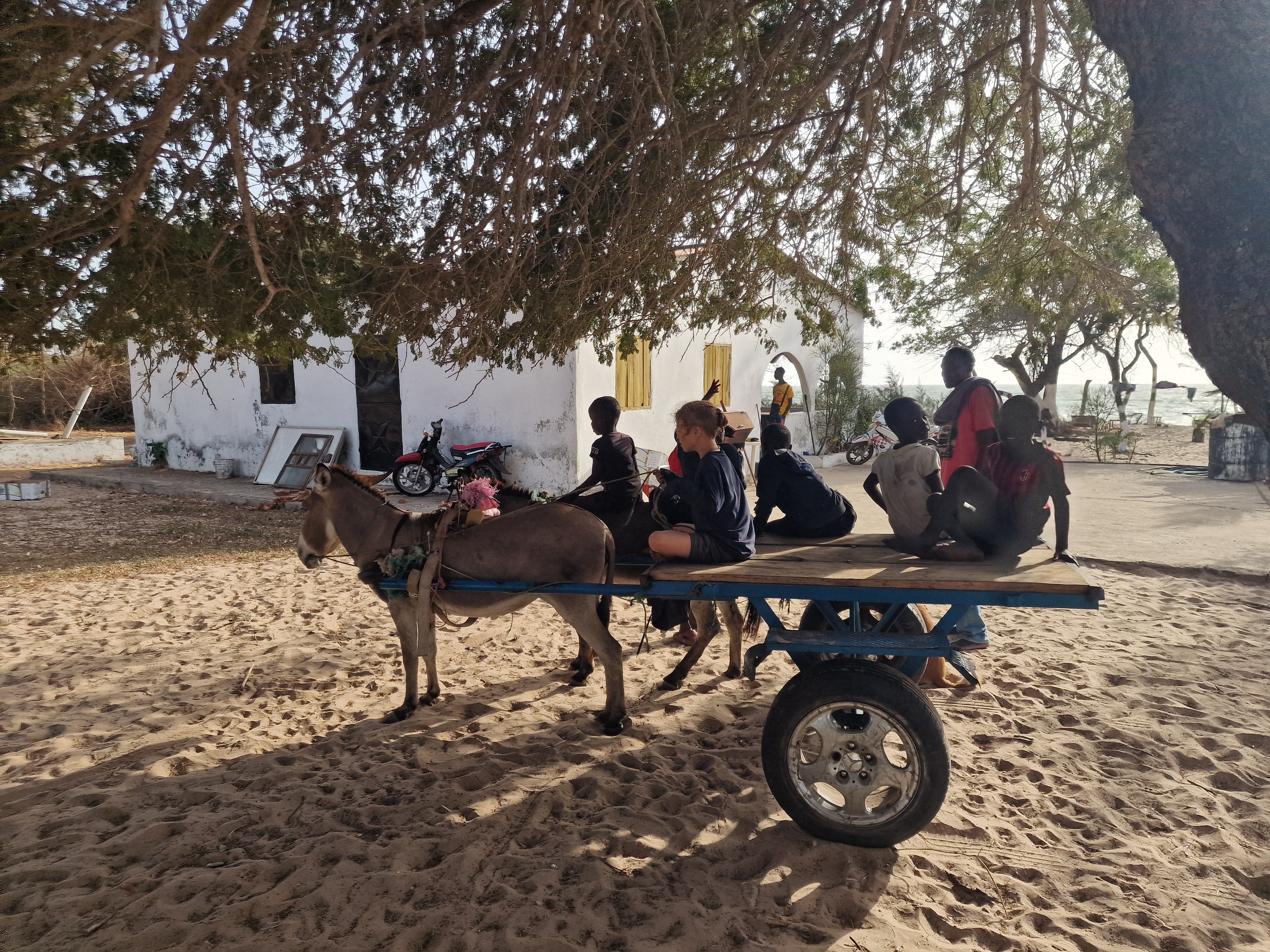
Forty five minutes later they returned, hot and cross.
“When we got to the village, one of the children started poking us with sticks! We asked her to stop and she didn’t. So we had to get off and walk home!”
Two days later, donkey was back under the tree. Just as contented-looking. Just as attended by children.
“Let’s go and ride on the cart. Maybe they won’t poke us with sticks again!”
Half an hour later, they returned. Again on foot. I was annoyed for them, but they didn’t seem cross at all.
“They did start poking us with sticks, so we just got off and walked home!”
And off they went to find crabs on the shore, leaving me to think about how different their responses were despite the exact same thing happening twice. I’d have been frustrated. Both with the other kids, and with myself for being fooled twice. They weren’t. They were happy enough to go off gallivanting again and not waste the afternoon. How? Why?
In my last article (here), I explored the value of helping children learn to manage their emotional responses to frustration (ie. helping them to develop “Frustration tolerance”), and one of the ways we could do that by showing less frustration-driven behaviours ourselves. (And, then, because I find it much easier to change my environment than just magically become a better person, I discussed how to set up a family environment that reduces parents’ feelings of frustration. From, as you might remember, personal experience).
But that’s just one part of the picture. Developing frustration tolerance isn’t just about seeing that behaviour from your parents, it requires practice and to practice you need an opportunity to practice.
To develop frustration tolerance, kids need to feel frustration. And, the evidence shows us that exposure to frustration isn’t enough - it needs to be the right type of frustration in the right amount.
What is the right amount?
Like any good craftsperson, we’ll start with quantity before getting onto sorting out quality. What is the right amount of frustration? Luckily for us as parents/carers/educators/doctors, the zone is really broad. Too little is none, and too much is ‘every experience is frustrating’.
(NB - If you’re looking for the actual scientific answer, the data doesn’t yet exist, but multiple experimental studies have shown that the optimum difficulty setting for learning any skill is around 85%. So, possibly, ensuring that life is un-frustrating enough that a child can successfully tolerate it over 85% of the time (and ensuring that things get harder with time) would be optimum? More studies needed).
That sounds easy enough, right? Any amount is fine so long as life isn’t literally all predictable and easy. The problem is, our WEIRD (Western, Educated, Industrialised, Rich, and Democratic) culture throws up some barriers against this low, low bar:
Supply chains and parenting styles - WEIRD children live lives of absolute plenty. Their every whim can be met. Crisp red grapes in the darkest depths of midwinter? Certainly, my cherub. New school trousers at 6pm on a Sunday because you forgot about Friday’s goal celebration knee-slides? Done in a jiffy! Don’t want to sweep up? Just let Roombie get it, darling.
I do it as much as any parent - Providing everything the instant it’s asked for, effusively praising every minimal effort, and inconsistently enforcing rules around chores, but these actions are, A, almost unique to WEIRD households, and, B, useless for teaching frustration tolerance. If children experience continual utopia, that is where they set their expectations.
Digital devices and compelling toys - Spectacular supply chains and fashionable parenting remove childhood frustrations of not getting what you want. The immediacy of digital play and entertainment, on the other hand, removes the frustrations of not getting things when you want. Where traditional play takes a long time to set up (all of which time is training determination for delayed gratification), modern play is often ready before the players are. A fast boot time is great and all, but it’s not teaching you patience.
Indoorsiness - The outdoors is hard work! First you have to actually go there, then it’s too cold or too hot, then a stinging nettle gets you in the back of the knee, and then just when everything is perfect, it starts to rain. Each and every trip outdoors trains us to handle frustration. Each and every hour spent indoors is a missed chance to do the same.
Risk aversion - At risk of sounding like a base jumper, adrenaline is a great teacher (, dude). Risky play (I’m talking about play involving heights, water, fire, speed, etc.) is obviously important for teaching appropriate risk management and reducing phobias. But it turns out to also be important to frustration tolerance. If you psych yourself up for something spectacular and scary, and then you fail in a painful way, you have to deal with every one of the four faces of frustration. You learn a huge amount. But you can’t do that if you live somewhere where kids aren’t allowed to take risks.
What is the right type?
So, the amount is clear: Some. Enough to make it a challenge to stay composed, which then gives children a chance to learn to stay composed and that learning stays with them the rest of their lives. But composed about what? What are the types of frustration to which we want to become tolerant?
The key science in this area was done in the early 2000s by a Scottish psychologist called Neil Harrington. He suggested all of frustration could be divided into:
Discomfort - (ie. ‘My attempt to get comfortable hasn’t worked’)
Denial - (ie. ‘My attempt to get a thing hasn’t worked’)
Conflict - (ie. ‘My attempt to relate hasn’t worked’)
Failure - (ie. ‘My attempt to achieve something hasn’t worked’)
So what does it look like to be intolerant of these sorts of frustration?
If we don’t learn about and learn to tolerate discomfort, we believe that life should be easy, comfortable, and free of effort or inconvenience.
If we don’t learn about and learn to tolerate not getting what we want, then we come to believe that we deserve instant gratification and that other people must give us what we want. (This is the only type of frustration intolerance that has a common name - ‘entitlement’).
If we don’t learn about and learn to tolerate the emotional distress of conflict, then we start to believe that relationship tension or conflict is unbearable and must be avoided at all costs.
And, perhaps the most important for our own later success in our endeavours, if we don’t become intimately acquainted with (and learn to tolerate) failure, then we believe that obstacles to achieving goals are never worth the risk of attempting, and that easiest options are always best.
And, eventually, the world shows that it doesn’t match our beliefs and then two things can happen - either we suffer emotionally (e.g. people who can’t tolerate the frustration of emotional distress are more likely to become anxious, depressed, and not be assertive), or we do behaviours to make the world match our beliefs (e.g. entitled people are more likely to get angry and more likely to bully others).
And all of this suffering is avoided by getting the right amount of the right types of frustration early in life. So how can we enable this (without our children thinking of us as really frustrating jerks who keep messing things up on purpose)?
What can we learn from traditional cultures?
In cultures where children spend a lot of time outside, unsupervised, and with responsibilities to their communities and families, parents have it easy*: frustration tolerance happens naturally. Children are exposed to many sorts of frustrating environments, with which they learn to cope. (And, echoing last week’s article, in many traditional societies, the adults they see have learned very strong frustration intolerance, so frustration is almost never modelled).
Additionally, parents rarely tell children what to do. Michaeleen Doucleff’s book ‘Hunt Gather Parent’ has some great examples of how parents guide children using non-verbal signalling, modelling, and shaping. As I learned from my children (see here), it’s hard to feel offended by a hand signal**.
In some cultures, it is considered inappropriate to tell others what to do. The only time my parenting was criticised openly was in Malawi. We’d been waiting several hours for a bus, standing in a hot, dusty bus station. My five year old was running around with a Malawian child, playing chase among people and bags. I tried to get his attention, I raised my voice, I tried to catch him by the arm as he ran past. A woman turned around.
“Leave him! He is a child. He does no harm.”
When parents don’t tell children what to do, they are rarely a source of frustration for the child. This means that a child learns frustration from the environment, not from people.
This means two things: 1, there’s no strain put on the parent-child relationship by frustration or learning frustration tolerance.
And, 2, unlike parents, environments don’t react to frustrated behaviour. Whining doesn’t make the rain stop. Even the most severe tantrum can’t put a fish on your line. And sulking doesn’t stop a nettle stinging. Zero reaction leads to very fast learning!
Kids taught by their environment develop an incredible capacity for frustration tolerance.
What should we do?
Provide plenty of unsupervised, unstructured outdoor time: Give them plenty of outdoor time, with as little supervision as possible, where they have to entertain themselves. Let them learn how to deal with discomfort, create their own entertainment, and learn to cooperate with siblings and peers. This article has some wonderfully evocative suggestions for giving children what they really want, and many of these provide good frustration. And this article explains why we need to think hard about creating spaces that enable this unsupervised, unstructured outdoor time.
Let frustration come from the environment, not from the parent. One of the easiest ways to do this is to make yourself stay silent when your child is feeling frustrated. Our instinct is to start explaining/excusing/offering/advising and this usually increases a child’s frustration. Try timing yourself for five minutes without using words. Sympathetic facial expressions, noises, or touch are fine.
Avoid logical consequences - logical consequences sound great, and can have their place. But too often, they are used as a form of punishment, and the parents are clearly the source (and therefore a target for frustration). Instead, allow children to experience the natural consequences of their actions (but DO protect them from severe physical injury!) and then parents can empathise rather than blame.
So, being able to deal with frustration is a key child skill, allowing them to (for example) thrive in education and social settings, and a key adult skill. Adults who can better control their emotions are healthier and even age more slowly, but the benefits go beyond this.
A person who is unfrustratable can take a scattershot approach to success - trying a thousand approaches to find the one that works, and then sticking with it until fruition. But an adult who cannot deal with frustration will be a difficult colleague, a short-term friend, and an impatient and angry parent.
Helping children learn about managing frustration is utterly essential and WEIRD culture makes it taboo.
Which, I’m sure you’ll agree, is really frustrating.
* - In this one specific way
** Battle of Agincourt reminders notwithstanding
The next article will be the final one in this set. The first (here) talked about reducing parental frustration. This one talked about allowing children to feel frustration. The third will discuss why we need to avoid programming frustration in babies.
If you’re interested in what it’s like to use this approach in practise, come join me and my partner Greg in this podcast episode as we talk about our choices and our experience. We also talk about how independent mobility might influence a child’s wellbeing, and how different types of light affect the risk of short-sightedness in tree shrews. Finally, we talk about our children’s school’s new sliced-grape policy, and the risks it poses to children’s health.

My veterinary degree taught me about mammalian body systems.
My career in health research taught me about Western health and Western bodies.
Spending 18 months living with my three children in remote African and South American communities taught me about human health and human bodies in other cultural environments.
I share what I’ve learned about child physical health and development in weekly articles and podcast episodes.
Everything is free, but if you find my work useful and would like to show your support, you can now upgrade – completely optional, always appreciated.
You may also be interested in:


Prefer a podcast?


Notes
Frustration Discomfort Scale: https://onlinelibrary.wiley.com/doi/10.1002/cpp.465
“In a prospective longitudinal study of high-school seniors (N = 391), MTFT scores predicted grade-point average and standardized achievement test scores, and—more than 2 years after completing the MTFT—progress toward a college degree. Though small in size (i.e., rs ranging from .10 to .24), frustration tolerance predicted outcomes over and above a rich set of covariates, including IQ, sociodemographics, self-control, and grit.” https://psycnet.apa.org/buy/2018-59119-001
“The present findings show that entitlement is the type of frustration intolerance belief that contributes the most to bullying involvement. Interventions targeting irrational entitlement beliefs and reinforcing rational ones could be considered when dealing with adolescent bullying.” https://link.springer.com/article/10.1007/s10942-021-00402-6
“Results indicated that maternal psychological control positively predicts frustration intolerance, and that in turn, frustration intolerance positively predicts school learned helplessness.” https://journals.sagepub.com/doi/abs/10.1177/0143034318775140
“Regarding unhealthy emotions, structural equation modeling (SEM) analyses (model A) indicated that discomfort intolerance and emotional intolerance had a significant relationship with state anxiety, trait anxiety, and depression. The discomfort intolerance and entitlement sub-scales had a significant relationship with state anger and trait anger, while entitlement directly predicted trait anger.” https://journals.sagepub.com/doi/abs/10.1177/0143034318775140
It’s not unusual for a child younger than 4 to have as many as nine tantrums per week. These can feature episodes of crying, kicking, stomping, hitting, and pushing that last five to 10 minutes, says Denis Sukhodolsky, PhD, a clinical psychologist with Yale Medicine Child Study Center. Most children outgrow this behavior by kindergarten. https://www.yalemedicine.org/conditions/anger-issues-in-children-and-teens
“Tonic irritability was independently associated with concurrent parent-reported temperamental negative affectivity and internalizing and externalizing disorders at age 6 and predicted higher rates of internalizing psychopathology, and suicidal ideation, in adolescence. Phasic irritability was independently associated with concurrent parent-reported temperamental negative affectivity, surgency, and low effortful control, maladaptive parenting styles and practices, and externalizing disorders at age 6, and predicted higher rates of externalizing psychopathology in adolescence” https://pubmed.ncbi.nlm.nih.gov/36029221/
Children who exhibit pathological irritability demonstrate a persistently angry, grumpy mood over extended periods (also known as tonic irritability) and frequent, situationally inappropriate temper tantrums that are not aligned with their developmental stage (described as phasic irritability). Irritability is among the leading symptoms for referrals to child and adolescent mental health services. Among youths, the prevalence of irritability ranges from 20–30% under a broad definition to 1–3% for severe chronic forms. https://link.springer.com/article/10.1007/s00787-024-02591-8
Future research directions are discussed, including methodological considerations as well as evaluating how emotion regulation skills training and improved parental frustration tolerance may prevent parent-child aggression. https://link.springer.com/article/10.1007/s10826-017-0764-y
This is fantastic, Guen! I agree on all counts, especially about letting frustration come from the environment instead of the parents. When the environment is so plentiful, it's really hard to adjust it to foster enough frustration and most of it tends to come from and be directed at parents. That's why plenty of unsupervised, unstructured outdoor time is so important. I appreciate the notes, will go through them!
I love this series! So helpful.