

The clamour of children’s voices faded into the distance as my elder two children disappeared with their friend to fact-check the rumours of there being a snake in the library. Other than the droning of the bugs, the only noise remaining in the palm-thatched benab (it’s like a hall, but doesn’t have any walls), was the shrieking, laughing and occasional sobbing of a pair of two-year-olds playing with a ball. One was mine, the other belonged to our neighbour in the village. His eight-year-old sister was watching him. And I was watching her.
Chasing a ball is hard when you’ve only just got control of your legs. Especially when the floor is slanted and uneven (and when intermittent chickens wander into the benab to distract you). Each time they fell, the two players would look around, clamber back to their feet, and set off again.
The big sister was supporting the game - running off to collect the ball when it escaped them, hoisting toddlers back to their feet when they couldn’t work it out, and occasionally cuddling or tickling them if a fall had been particularly surprising. But there was one thing she never did.
She never stopped them falling over.
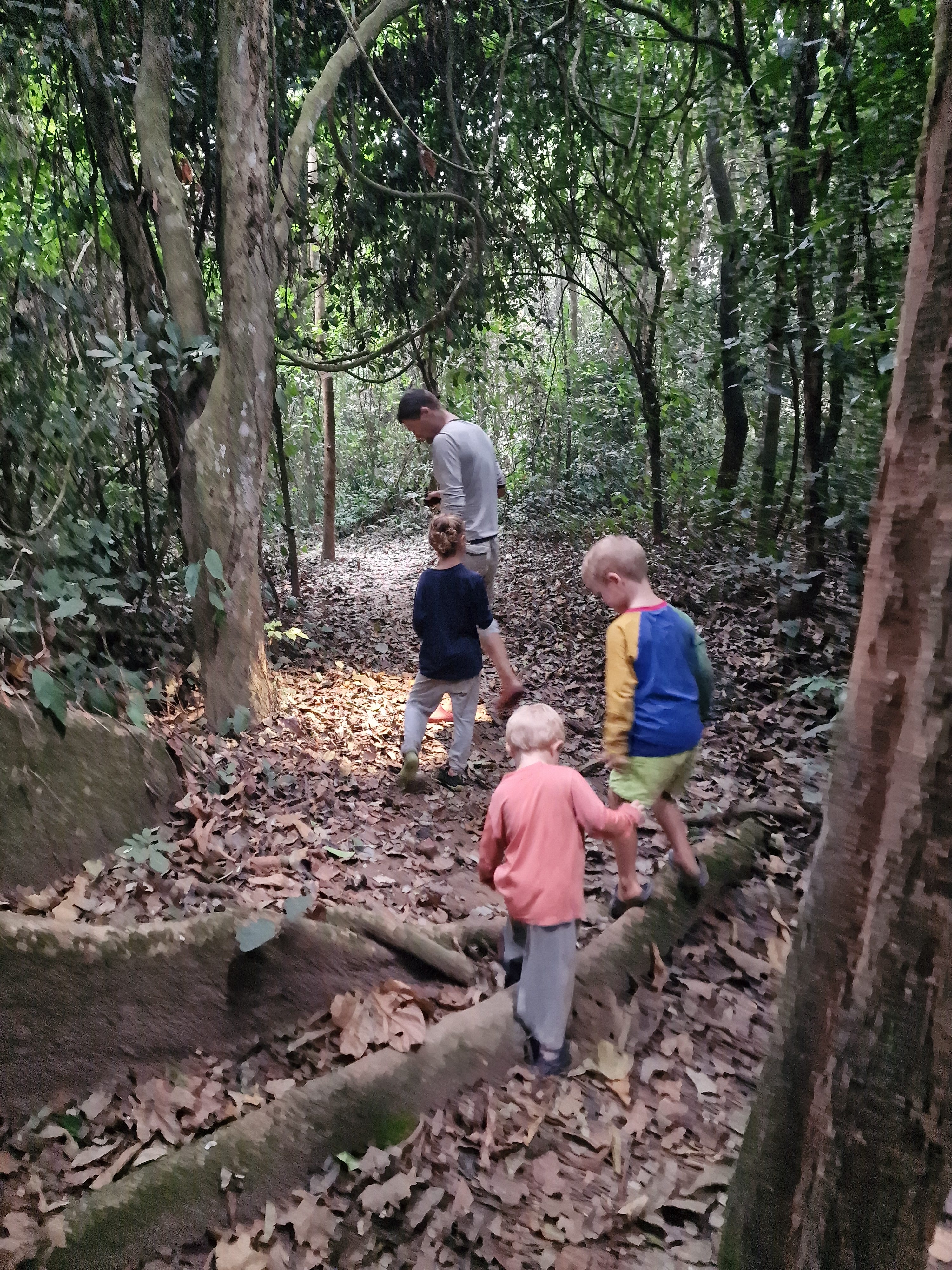
In the eighteen months we were invited to live in tropical traditional communities, I watched many children fall over in many ways. Especially toddlers. My own littlest one seemed to have permanent bruises and scrapes, always on her knees, often on her face. My goodness, I’d never seen toddlers fall over so much.
But it seemed I was the only one surprised. My friends in the Amazon, like those in Central Africa, reacted to many things about my kids - from their white blonde hair, to their hesitance when confronted with spicy food - but never once to them falling over. Adults rarely reacted at all when any children or toddlers toppled. Parents didn’t try to catch them. They didn’t rush over to help. They didn’t praise bravery after the event. They barely showed that they noticed at all.
And while I saw a lot of toddlers falling over, I saw a lot of older children who didn’t.
What do bodies need?
All over the world, babies and toddlers fall over. A lot. Both from sitting and standing. It’s important to learning balance and, as long as they do their falling early, while they’re still pretty light, they don’t seem to mind. They haven’t yet learned the skill of reacting to destabilising forces and shifting their weight to withstand them. In short, they haven’t learned how to balance.
Learning to balance has three parts. Children need to:
Calibrate the balance sensors (consisting of the accelerometers in the inner ear, the stretch-sensitive spindle sensors in the body’s tendons, and the pressure sensors in the skin),
Use those calibrated sensors to learn how far they can lean without falling over,
Use that experience to start to avoid movements that are going to push you beyond that point.
As you will have spotted, steps two and three require falling. That’s one of the reasons it’s much easier to learn this skill when you’re small: You are lighter and closer to the ground, so falls don’t hurt as much (and they provide useful training in coping with everyday pain: more on the benefits of that here).
There are two other reasons to learn balance when you’re as tiny as possible:
You’re really motivated to practice.
You tend to move in a very wide variety of ways.
When children don’t learn how to balance well in early childhood, they often don’t catch up, retaining a worse sense of balance into adulthood when, if they can’t balance well and are no longer motivated, they can just choose to avoid those movements. Who needs to slack-line anyway?
But great balance isn’t really an optional skill. As we get older and our bodies get weaker, balance becomes more and more important. The better our balance was to begin with, the longer it will last. If you had good balance skills when you were ten, you’ll be less likely to fall and fracture your hip when you’re eighty.
Why doesn’t it happen?
OK, so learning to balance in childhood is a fundamental movement skill that will protect those children that manage it well into adulthood.
But W.E.I.R.D. (i.e. from communities that are Western, Educated, Industrialised, Rich, and at least a bit Democratic) children’s balance skills are deteriorating. Why?
A large part is just that W.E.I.R.D. children move less. They walk less (more here), use their upper bodies less (more here), sit on the floor less (more here), and go outside less (more here). And if you’re moving less, you’re less likely to fall down. Which means you get fewer chances to learn how to avoid it.
Childhood inactivity has worsened for many reasons - COVID, screen time, societal intolerance of outdoor play, car dominance, and many others. And, at the same time, we’ve got much more risk averse. Our communities have gone to extraordinary lengths to remove discomfort and risk from everyday life (more on our cultural infantilisation of children here). And falls, being both uncomfortable and risky, are an obvious thing to prevent. Scare stats like “falls are the most common cause of serious injury in toddlers” mean that parents are pushed to pay much more attention to the short-term toddler comfort benefit, rather than the long-term detriment to their fitness and health.
But that statistic is misleading. The vast majority of falls that result in serious injury are falls from a height. Sure, occasionally a toddler (like one of mine did) will be unlucky and fall over and cut their face on a gravel path, but ‘falling over’ is not the same as ‘falling off of’. It’s a whole different form in A&E.
Nevertheless, WEIRD baby environments are engineered to prevent falling over (think backed seats, baby bouncers, and parents diving to intercept before a wobble can become a topple). Nurseries and childcare facilities are designed to reduce the risk of children falling. The Health and Safety Executive, a UK Government department, says “Children can be seriously injured from falling over common household items like floor brushes, shoes and clothing. Toys and books are also a tripping and falls hazard. Keep floor surfaces, corridors, passage ways and stairs clear.” All of which is true. In theory. But completely misses the much bigger risk that’s waiting for them if they never fall over.
Given how much we WEIRDos love risk-reducing devices, I wasn’t surprised to also find a paper describing an ‘early-warning childcare system to monitor fall-prone behaviours of toddlers at home.’ The authors write, “It is extremely important to trigger an alarm early so toddlers are alerted to stop behaving dangerously and caregivers have time to intervene to avoid accidental falls.” Stop behaving dangerously. Avoid accidental falls. Hmm.
We’ve got really good at preventing children from falling over. Great for reducing their small risk of short-term injury, terrible for increasing their large risk of long-term inactivity.
What can we learn from traditional cultures?
Before we travelled, I’d never lived anywhere where I looked really different. But living in countries across South America and Africa made me appreciate how observed you feel when you’re more noticeable than everyone else. And my goodness, EVERYTHING I did was noticed. “What is the white woman feeding her child?”, “Why is the white child crying?”, and, when it came to falling, “Why does that white woman interfere with her child’s learning?”.
In the villages in which we lived, parents didn’t interfere with children’s activities nearly as much as we do in the UK. There was much less guiding, instructing, encouraging, and discouraging. They believed that it wasn’t their right to tell children what to do.
Instead, parents let children learn.
And certain aspects made it easier.
Time outside: Homes were small and mostly a place to sleep. This meant that toddlers were outside a lot of the time. And when compared to the inside of a WEIRD home, the outside parts of a Traditional village (all over the world) often have fewer edges, grippier ground, and fewer high steep edges from which you can fall badly. However, they also often have more uneven ground, more trip hazards, and more obstacles to avoid. All of which mean that early falls are more likely but less consequential.
Being looked after by older children: Older children who’ve learned how to look after toddlers can be motivated, caring, committed caregivers. But they are rarely quick enough to anticipate simple falls. This means that toddlers supervised by older children have many more opportunities to fall down and get up again. And older children don’t empathise with toddlers as much as adults try to. They certainly don’t coo and swoon and rush about if a little’n falls over. Toddlers, therefore, don’t learn that falls are scary and something to be avoided.
Unstructured time: Toddlers were not deliberately entertained. That was not a job that parents felt they had to do. Instead, they had a lot of time to learn and explore - and this meant that they moved a lot. They had the time and motivation to spend hours practicing falling over every single day.
How can we help our toddlers to fall down?
You’ll notice a certain familiarity to this section. This is one of those rare articles where there really is a solution for every challenge!
Get toddlers outside as much as possible! Outside is:
more interesting (so children move more);
less predictable (so children have to learn to react and adapt).
inherently impossible to make entirely harmless (so we as adults have to make the conscious decision to stop fretting and let them get on with things).
Supervise like a child:
Don’t react.
Reframe falls as learning, not as failure.
If you can’t do that, don’t watch! Let children spend time with adults who aren’t so reactive (got a clueless relative who doesn’t have kids? Now is their time to shine!).
Don’t try to fill a toddler’s time. Children need time to learn how to balance. When we structure every minute of a child’s day, we don’t give them the opportunity to find joy in surprising movement, in unexpected wobbles, and in repeating a difficult movement until they succeed.
And they really do find it, you know? Joy in unstable movement and skating the edge until they fall over, and then getting up and doing it again. We forget. Decades will do that to you. And falling over isn’t anywhere near as bad for them as it is for us! More pro, less con.
It’s really hard watching a child fall down, especially when you know that you could have prevented it. You feel guilty. You shouldn’t. Framing falls as failures means that we don’t recognise them for what they are - critical moments for learning the extent of the body’s capacity to react.
Children need to fall to learn how to not fall.
During my veterinary training, I thought I understood how bodies worked. Ten years ago, I discovered the work of Katy Bowman, a visionary biomechanist, and I realised that I hadn’t got a clue about how bodies moved. I love all her books - but ‘Move your DNA’ shows you what movements your body has evolved to need, ‘My Perfect Movement Plan’ helps you work out which movements are missing, and ‘Grow Wild’ is written for parents with so many amazing ideas to help children move more. I’ve just found her on Substack here - if you haven’t come across her before, go check out her work. It’s life changing.
My veterinary degree taught me about mammalian body systems.
My career in health research taught me about Western health and Western bodies.
Spending 18 months living with my three children in remote African and South American communities taught me about human health and human bodies in other cultural environments.
I share what I’ve learned about child physical health and development in weekly articles and podcast episodes.
You may also be interested in:


WEIRD laundry habits can increase the risk of eczema and allergies. How can we wash clothes better?
Prefer a podcast episode?


Notes
“Poor static balance at age 10 was strongly associated with worse balance ability at age 46.”
In contrast to fall detection (detect after lying down) [2–7] and pre-impact detection (detect descending in just a few milliseconds before the first impact) [8–11], we propose an early-warning system to identify fall-prone behaviors, assess fall risks, and predict potential fall dangers in the relatively long-term future (a few seconds). “ https://www.mdpi.com/1424-8220/13/12/16985
Pre- and post-COVID balance assessment in Japanese children. “Children in the after group had a higher body fat percentage (p = 0.037), shorter single-leg standing time (p = 0.003), and a larger number of falls per month (p < 0.001) than those in the before group.” https://pmc.ncbi.nlm.nih.gov/articles/PMC8466877/
I have followed your work for a while and adopted this approach while raising my 14 month old. She is getting better but she still launches into a blood curdling scream after many of her falls, even if they don't appear to have hurt much. It's hard not to feel, and look, like a negligent parent! I do notice though that falls bother her a lot less when we're outside. Maybe the answer is just more outside time.
All my kids came home from daycare having learned one very important thing: RUNNING IS DANGEROUS. If that's what they're being taught as littles, lack of movement is everything downstream of that.